Michigan Senate Primary
Michigan Democratic U.S. Senate Primary Briefing
A sourced look at the Abdul El-Sayed versus Haley Stevens primary, including polling, money, policy contrasts and the counties to watch on election night.
Primary Frame
Movement vs. Institution
El-Sayed offers structural reform; Stevens offers governing experience and institutional strength.
Polling
El-Sayed Favored
The late signal points toward El-Sayed, even though one older live-phone poll showed a Stevens path.
Money
AIPAC/PAC Wave
Campaign fundraising is competitive; the outside advertising imbalance heavily favors Stevens.
November
Mike Rogers
The Democratic nominee is expected to face Republican Mike Rogers for the open seat.
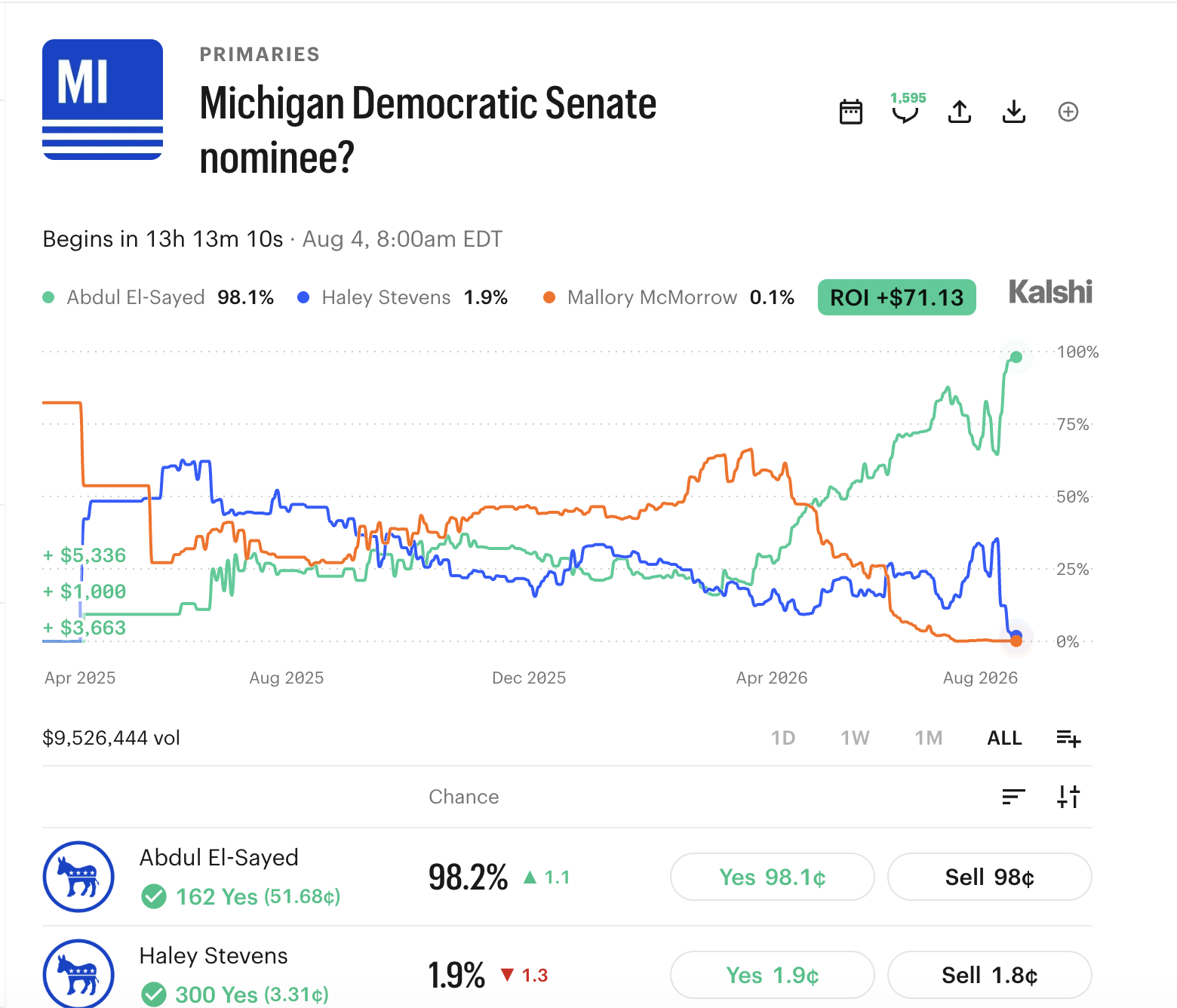
Late Market Signal
Kalshi shows El-Sayed as the overwhelming favorite.
Prediction markets are not election results, but the final pre-primary market move is an important signal of where sophisticated late money believes the race stands.
Kalshi's Michigan Democratic Senate nominee market shows Abdul El-Sayed at roughly 98%, Haley Stevens near 2%, and more than $9.5 million in reported volume. That is not a certified result, and markets can be wrong. It does mean the race has moved from competitive to overwhelming El-Sayed advantage before polls open on August 4.
El-Sayed is the clear late favorite. Stevens' remaining path depends on an older, more absentee-heavy electorate than the late polling and market data suggest.
Executive Brief
Michigan is testing two Democratic theories of power.
The winner inherits an open-seat general election in a state Trump carried in 2024, with Republicans positioned around Mike Rogers.
The Democratic primary is a genuine strategic and ideological choice. El-Sayed offers a movement-driven, anti-establishment program centered on Medicare for All and opposition to big-money politics. Stevens offers a four-term congressional record centered on manufacturing, institutional alliances and a more incremental policy approach.
The money imbalance is historically large, and the final public polls are technically mixed. But the late signal is no longer neutral: Emerson, Kalshi and the visible movement-energy indicators point toward El-Sayed. Stevens' remaining path depends on a primary electorate older, more habitual and more absentee-heavy than the late indicators imply.
Michigan Democrats are choosing between movement energy and ideological clarity versus governing experience and institutional strength, with El-Sayed entering primary day as the clear late favorite.
Movement Pressure
- Public-health executive, epidemiologist and former 2018 gubernatorial candidate.
- Signature issues: Medicare for All, campaign-finance overhaul, affordability and arms embargo on Israel.
- Coalition signals include Sanders, Warren, AOC, Tlaib, UAW and National Nurses United.
- Central vulnerability: progressive positions may be harder to carry statewide, and he has not previously won elected office.
Institutional Strength
- Four-term U.S. representative and former auto-rescue task-force chief of staff.
- Signature issues: manufacturing, supply chains, ACA and Medicare protection, workforce and pro-Israel two-state position.
- Coalition signals include Whitmer, Peters, Stabenow, Nessel, Clyburn and labor/elected-official networks.
- Central vulnerability: outside-money dependence narrative, Israel attacks and a less detailed public platform.
State Of The Race
The late indicators point to El-Sayed.
The polls can be described as mixed in a technical sense, but the final read should not sound neutral. The newer polling and market data favor El-Sayed.
| Poll / Field Dates | Method | Result | What It Means |
|---|---|---|---|
| Emerson College, July 26-27 | 700 likely Democratic primary voters; credibility interval +/-3.7 | El-Sayed 54, Stevens 39, undecided 6. With leaners: 57-41. | Large El-Sayed lead, especially among voters under 50. This is the most important late public polling signal. |
| WDIV / Detroit News / Glengariff, July 8-11 | 500 likely Democratic primary voters; live telephone; MOE +/-4.4 | Stevens 48.2, El-Sayed 41.4, undecided 10.4. | Earlier field period and different mode. Useful for understanding Stevens' turnout path, not for neutralizing the late El-Sayed advantage. |
Emerson showed El-Sayed leading heavily among voters under 50, while Stevens led among voters over 60.
The practical question is how much of the electorate is younger, independent, Arab or Muslim, progressive and newly mobilized.
El-Sayed is the clear late favorite, though the older Glengariff survey shows why turnout composition still matters.
Money
Campaign money and super PAC money are different stories.
The candidate committees are competitive. The decisive imbalance is outside advertising.
El-Sayed outraised Stevens in total campaign receipts through July 15, while Stevens held modestly more cash on hand. The larger story is outside money: independent groups led by AIPAC's United Democracy Project and other pro-Stevens organizations created an advertising advantage measured in tens of millions of dollars. These are not direct donations to Stevens and, by law, may not be coordinated with her campaign.
| FEC Measure Through July 15 | Abdul El-Sayed | Haley Stevens |
|---|---|---|
| Total receipts | $14,528,335.93 | $11,884,632.43 |
| Individual contributions | $14,408,058.06 | $9,216,539.84 |
| Other committee contributions | $71,845.23 | $708,306.00 |
| Total disbursements | $11,975,573.38 | $9,091,338.23 |
| Cash on hand | $2,552,762.55 | $2,793,294.20 |
| Outside Money Signal | Reported Figure | Why It Matters |
|---|---|---|
| AIPAC and affiliated groups | AP reported close to $30 million backing Stevens, described as AIPAC's largest single-race investment. | This is the headline outside-money figure, with the important caveat that the spending was independent support and opposition spending. |
| United Democracy Project | Bridge reported nearly $25 million by July 24 on ads touting Stevens or criticizing El-Sayed. | The cleanest specific AIPAC-super-PAC figure for the final stretch. |
| A Stronger Michigan | AP and Bridge reporting identified it as a major pro-Stevens outside-spending vehicle, with roughly $12 million in early July activity. | It was a pro-Stevens outside group, with donor-disclosure timing limits relevant to understanding the spending. |
| Total pro-Stevens outside ecosystem | AP reported outside organizations had poured close to $50 million into boosting Stevens. Bridge/AdImpact later referenced roughly $60 million in reservations. | Distinguish completed spending from ad reservations. |
| Fighting for Michigan and other pro-El-Sayed outside groups | Bridge reported roughly $2 million from Fighting for Michigan by late July, far smaller than the pro-Stevens outside spending. | Useful context, but it does not change the overall spending imbalance. |
AIPAC-affiliated groups and related pro-Stevens PACs spent or reserved large sums independently to support Stevens or oppose El-Sayed. That money was not a direct campaign donation.
Candidate Fact Sheets
The affirmative case for each candidate.
The contrast is biography, coalition, policy agenda and the vulnerabilities each candidate would carry into November.
Public Health Populism
- Age 41; Southeast Michigan native; Muslim and Egyptian-American; would become the first Muslim U.S. senator if elected.
- University of Michigan graduate, Rhodes Scholar, doctorate in public health from Oxford and M.D. from Columbia.
- Former Detroit health director and Wayne County health official.
- Program record includes vision services, lead and water work, Narcan distribution, air-quality monitoring and medical-debt relief partnership.
- Electoral record: placed second in the 2018 Democratic primary for governor and has not previously won elected office.
Manufacturing Democrat
- Age 43; raised in Oakland County; lives in Birmingham.
- Worked on Barack Obama's auto-industry rescue team and served as chief of staff to the Presidential Task Force on the Auto Industry.
- Won a Republican-held House seat in 2018 and is serving a fourth term.
- Committee profile includes education, workforce, science, technology and China-competition issues.
- Legislative record includes STEM, CHIPS and Science Act work, pension rescue and manufacturing competitiveness.
| Issue | El-Sayed | Stevens | Key Difference |
|---|---|---|---|
| Health care | Single-payer Medicare for All with no premiums, copays or deductibles. | Protect and expand ACA, Medicare and Medicaid; lower costs. | Structural replacement versus incremental expansion. |
| Campaign finance | No corporate PAC money; overturn Citizens United; public financing; restrict outside groups. | Supports reform but accepts traditional PAC support and denounces uncoordinated spending. | Purity and structural argument versus coalition and pragmatic argument. |
| Israel / Gaza | Immediate arms embargo; calls Gaza genocide. | Continue alliance and aid; supports two-state solution; rejects embargo. | The sharpest substantive and coalition divide. |
| Immigration | Abolish ICE as an agency and reorganize enforcement. | Overhaul ICE, discipline misconduct and retain agency functions. | Institutional abolition versus reform. |
| Manufacturing | Antitrust, targeted tariffs, labor power and onshoring. | CHIPS, industrial policy, supply chains, trade and workforce expertise. | Both prioritize industry; Stevens owns the deeper congressional brand. |
| Climate / energy | Close Line 5; 100% renewable pathway; water affordability rules. | Clean manufacturing, PFAS and lead cleanup, utility accountability. | El-Sayed is more explicit on deadlines and prohibitions. |
Vulnerabilities And Fact Checks
Claims that need careful language.
The strongest version of the argument still needs careful phrasing where the evidence is narrower than the campaign rhetoric.
Claim Check
- Medical debt: He launched a program with a $700 million goal; verified relief was about $57 million at the last published cutoff.
- Medical background: He has an M.D. and is an epidemiologist and public-health official; he did not practice clinical medicine.
- Defund police: His 2020 rhetoric aligned with reallocating police resources, though he now rejects the shorthand label.
- Uncommitted: He participated in the movement; he was not its leader.
- Republican meddling: Republican messaging suggests they may prefer him as an opponent; no evidence shows direct funding of his campaign.
Claim Check
- AIPAC: Outside groups spent independently; the money was not a direct campaign contribution to Stevens.
- $60 million: Distinguish ad reservations from completed spending.
- Obama: Ads can cite past Obama praise of auto-rescue work; that is not a 2026 primary endorsement.
- ICE votes: The votes occurred, but slogans omit broader bill contexts.
- Effectiveness: One academic index ranked her the most effective Michigan House Democrat, not the most effective member of the delegation.
Field Guide
What to watch on election night.
The result will show which version of the Democratic electorate actually appeared.
Detroit turnout, Arab and Muslim communities, and whether El-Sayed converts intensity into ballots beyond his geographic base.
Stevens' home base and professional-suburban coalition. The margin here is more important than simply winning it.
Ann Arbor progressives and university-linked voters. A likely El-Sayed strength to measure early.
Working-class and union voters; evidence for which economic message travels beyond core ideological voters.
Absentee ballots may reflect an earlier Stevens-leaning phase; Election Day votes may reflect late El-Sayed momentum. Treat that as a hypothesis, not a fact.
The nominee must immediately unite these factions against Mike Rogers in a state Trump carried.
Claim Check
How to read the contested claims.
Campaigns often compress complicated records into short claims. The distinctions below keep the facts clear.
| Avoid | Use Instead |
|---|---|
| "AIPAC gave Stevens $30 million." | "AIPAC-affiliated groups spent or reserved roughly $30 million independently to support Stevens or oppose El-Sayed." |
| "Outside groups spent $60 million." | "Ad trackers reported roughly $60 million in reservations; completed-spending estimates were lower." |
| "El-Sayed erased $700 million in debt." | "He launched a program authorized to erase up to $700 million; about $57 million was verified at the fact-check cutoff." |
| "El-Sayed is a practicing physician." | "He has an M.D. and is an epidemiologist/public-health official; he did not complete residency or hold an active clinical license." |
| "Obama endorsed Stevens." | "Stevens uses Obama's past praise of her auto-rescue work; he had not endorsed the primary." |
| "Stevens personally saved 200,000 auto jobs." | "She served as chief of staff on the federal task force credited with helping preserve more than 200,000 Michigan auto jobs." |
Sources
Sources behind the analysis.
Government records establish dates, filings and results. Campaign pages show what the candidates say. Independent reporting and fact checks test the claims.
- Michigan elections and Aug. 4 primary information - Michigan Department of State.
- El-Sayed leads Stevens for Democratic nomination - Emerson College Polling, July 29, 2026.
- Michigan Democratic Senate primary poll - ClickOnDetroit / WDIV and Detroit News, July 14, 2026.
- Abdul El-Sayed candidate overview - Federal Election Commission.
- Haley Stevens candidate overview - Federal Election Commission candidate data.
- AIPAC has spent a record amount on Michigan's Senate primary - Associated Press, July 2026.
- Outside spending floods Michigan's U.S. Senate race - Bridge Michigan, July 13, 2026.
- Meet Abdul - Abdul El-Sayed campaign biography.
- Haley's biography - Office of Rep. Haley Stevens.
- El-Sayed endorsements - Abdul El-Sayed campaign.
- Stevens endorsements - Haley Stevens campaign.
- Fact check: Stevens, El-Sayed clash over AIPAC and electability - Bridge Michigan, July 27, 2026.
- Fact check: El-Sayed overstates $700M medical-debt claim - Bridge Michigan, 2026.
- Fact check: Did Stevens vote to fund and thank ICE? - Bridge Michigan, 2026.
- Fact check: El-Sayed's record on defund the police - Bridge Michigan, 2026.
- Fact check: party loyalty and Kamala Harris - Bridge Michigan, 2026.
- AIPAC is the top issue at the final primary debate - Jewish Telegraphic Agency, July 28, 2026.
- How to vote in Michigan - Michigan Department of State.
- Abdul El-Sayed fellow biography - University of Chicago Institute of Politics.
- Election results and data - Michigan Department of State.
- El-Sayed medical-license controversy - public license records coverage; use only for the narrow license-status claim.
- Mailman's El-Sayed takes health reins in Detroit - Columbia University Mailman School of Public Health, Sept. 10, 2015.
- El-Sayed policy priorities - Abdul El-Sayed campaign platform.
- Stevens HOPE agenda - Haley Stevens campaign platform.
- Kalshi market image - August 3, 2026.