
Michigan · November 3, 2026 · Ballot explainer
Michigan
Proposal 2.Utilities, contractors
and political speech.
The measure would restrict certain contributions and broaden campaign-finance rules for political communications. The filed text explains where each change begins.
Understand the proposalProposal 2 reaches beyond utility contributions
Michigan Proposal 2 would restrict certain utility and government-contractor contributions and expand the political communications covered by state campaign-finance law. The second part is substantial: some messages could trigger regulation without explicitly telling people how to vote.
That is the scope described in the official ballot wording. But a contribution prohibition, an advertisement’s payer identification and a spending report are different requirements. Calling all of them a ban on political speech would obscure what the measure actually says.
The November 3, 2026 question is an initiated law amending the Michigan Campaign Finance Act. A yes vote adopts that law; a no vote rejects it. It is separate from Proposal 1’s constitutional-convention question.
Inside the filed law
Proposal 2 changes
three sets of rules.
Who can contribute.
Which messages are covered.
What must be disclosed.
Contribution rules · Communication rules · Disclosure rules
Proposal 2’s rules
have different triggers.
donorsDefined utilities,
contractors & associated people
recipientsCandidates, committees
& other covered recipients
Contribution restrictions · Proposed Sections 30a–30b
01 / Contributions
Restrictions depend on both sides of a contribution.
The proposed bans use defined donor and recipient categories. They do not apply to every utility customer or employee merely because of that relationship.
Contract coverage generally requires aggregate value exceeding $250,000 in a calendar year. The contractor prohibition has a separate 18-month enforcement delay after the law’s effective date.
Read the conditions and exclusions →Inspect the filed provisions ↗02 / Communications
Some messages could be covered without “vote for” or “vote against.”
The broader expenditure definition and the new electioneering category are distinct. Applying the electioneering calendar to every communication rule would misstate the proposal.
Message content, spending, audience and retained exclusions still matter.
Compare the wording →Inspect Sections 5–6 ↗the payer.Section 47 · Communication identification
the spending.Section 51 · Specified electioneering reports
qualifying donors.Contributions for making electioneering communications
03 / Disclosure
Identification and reporting have different triggers.
A payer label, a spending report and donor disclosure are separate requirements. The report’s $5,000 threshold is not a universal exemption from other campaign-finance rules.
The donor provision concerns contributions of $100.01 or more for making electioneering communications.
Read the reporting requirements →Inspect Sections 47 and 51 ↗Editorial guide to the filed proposal. Read the full analysis for conditions and retained exceptions.
Read the change
Proposal 2 would broaden
the expenditure definition.
The distinction turns on what a communication says—even when it does not expressly tell people how to vote.
Current Section 6(2)(j) · Selected excerpt
“Except only for the purposes of section 47”Read the complete current provision ↗
…
“express words of advocacy of election or defeat”
Current law uses an express-advocacy limitation.
Section 6(2)(j) excludes certain communications that do not expressly advocate a clearly identified candidate’s election or defeat. The provision specifically preserves the application of Section 47.
These are selected excerpts. Other definitions and exceptions remain relevant to any particular communication.
Proposed Section 6(1)(b)(ii) · Selected excerpt
“PROMOTES, SUPPORTS, ATTACKS, OR OPPOSES A CANDIDATE, REGARDLESS OF WHETHER THE COMMUNICATION EXPRESSLY ADVOCATES THE ELECTION OR DEFEAT OF A CANDIDATE.”Inspect the proposed wording ↗
The proposal would reach beyond an explicit voting appeal.
The filed text deletes the current express-advocacy limitation and adds this candidate provision. A parallel provision addresses ballot questions.
That broadens the potential scope of regulation. It does not erase the need to examine the message, spending, definitions and retained exclusions.
The medium and context matter when assessing a message
These examples illustrate the distinctions in the text. They do not resolve every application of a law that would still require implementation.
A group pays to promote a state candidate’s policy record
The paid promotion fits the proposal’s internet definition. Its content could qualify under the broadened expenditure rule. If it clearly identifies a candidate, falls within the electioneering window and targets the relevant electorate, that separate category may also apply. Spending, donor purpose and the speaker’s status then matter for reporting.
An individual writes an unpaid social-media post
Without paid placement or promotion, the post does not meet the new paid-internet definition merely because it is online. Section 47(1) also retains an exception for an independent individual who is not a candidate and is not acting for a candidate or committee. Neither point should be turned into a universal exception from every provision or every form of spending.
A publication runs a regular news story or editorial
The existing Section 6(2)(d) expenditure exception for regular-course news, commentary and editorials remains. That is an important qualification to claims about all election coverage being regulated. The interaction of retained exceptions with the new communication categories may still require official interpretation; an exemption from one definition should not be described as immunity from every rule.
Examples are editorial analysis of the filed text. Retained member-communication, nonpartisan voter-registration and federal-candidate provisions also affect scope. Federal races have separate campaign-finance rules; a state-race example should not automatically be transferred to a U.S. Senate race.
Utility and contractor restrictions depend on the donor and recipient
Proposed Section 30a covers regulated electric and gas utilities, their defined principals and affiliates. It bars direct or indirect contributions to specified recipients, including candidates for governor, attorney general and the Legislature; state and local party committees; and certain committees and entities connected with covered candidates or officials. It also addresses donations to Public Service Commission members.
The definitions reach beyond the utility itself. Principals include directors, owners of at least 5 percent, specified officers, agents and lobbyists, and the immediate family of directors, qualifying owners and officers. These are defined categories—not a restriction on every utility customer or employee merely because of that relationship.
Proposed Section 30b covers government contracts that a person enters into or seeks, including qualifying subcontracts, with an aggregate value exceeding $250,000 in a calendar year. State contractors face restrictions involving state-office candidates and specified committees and affiliated entities. Local-contractor restrictions concern offices in the contracting jurisdiction. The measure excludes certain agreements, including loans and loan guarantees, appropriated grants and subsidies, collective bargaining agreements and agreements between political subdivisions.
The contractor prohibition would not be enforceable until 18 months after the law’s effective date. Its covered period also reaches contract negotiations or solicitation and can extend 18 months after a contract ends. Those timing rules should not be collapsed into a claim that every restriction starts on election night. Filed proposal, Sections 30a–30b, printed pages 2–3.
Two provisions broaden the communications covered by the law
The expenditure definition would reach some issue advocacy
Under proposed Section 6, spending on public communications that promote, support, attack or oppose a candidate or ballot question could be an expenditure even without an explicit appeal to vote. The proposal deletes the current express-advocacy limitation in Section 6(2)(j) and narrows the separate issue-communication exclusion.
This is why the speech question is real. An organization’s spending on a public message about an officeholder’s policy record could enter campaign-finance regulation even if the message does not say “vote against.” Coverage still depends on the message, the applicable definitions and retained exclusions. This provision does not have the separate 100-day limit described below. Filed proposal, Section 6; current Section 6 for comparison.
A new electioneering category would have a calendar and audience test
Proposed Section 5 defines an electioneering communication around a clearly identified candidate, even without express advocacy. It must be publicly distributed within 100 days before a general election or 30 days before a primary or special election in which that candidate is on the ballot, and target the relevant electorate.
The media definition is broad, and the secretary of state would write rules defining the targeting requirement. This candidate-based category is distinct from the broader expenditure provision, which also addresses ballot questions. Applying the 100-day window to every communication rule would misstate the proposal. Filed proposal, Sections 5–6.
Payer identification and spending reports have different triggers
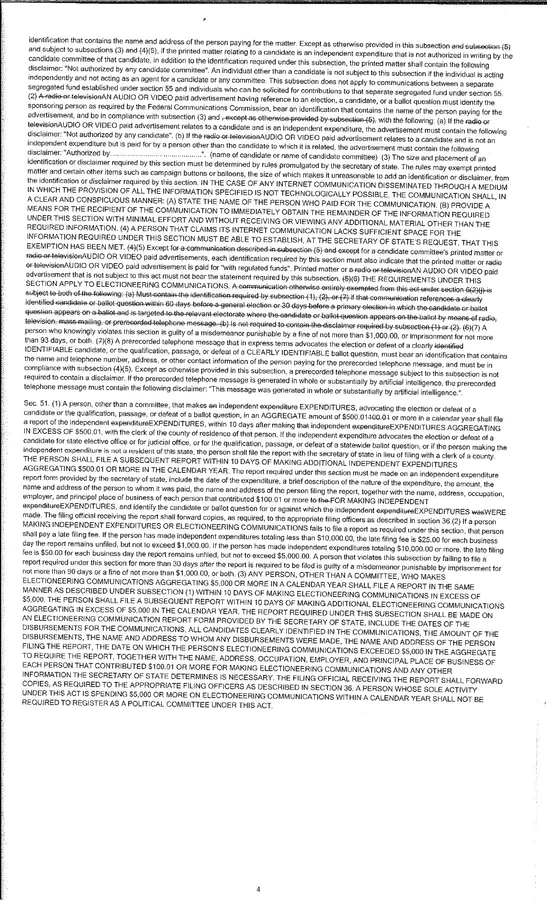
Proposed Section 47 expressly extends identification requirements to internet communications and electioneering communications. The new definition of an internet communication concerns paid placement or promotion on another person’s website, device, application or advertising platform. It does not simply define every unpaid social-media post as an internet advertisement.
Separately, Section 51 would require a person other than a committee making electioneering communications to file reports at the specified annual $5,000 spending threshold. Its filing deadline uses spending in excess of $5,000 and requires a report within 10 days. This is not a universal $5,000 exemption: committee rules, independent-expenditure reporting and identification requirements have their own triggers.
That report would identify contributors who gave $100.01 or more for making electioneering communications. That language matters; it is not the same as saying this particular provision automatically publishes every donor to every organization. The proposal also says spending solely on electioneering communications does not, by itself, require registration as a political committee. Filed proposal, Sections 47 and 51; Section 9’s internet definition.
Advocacy groups disagree about transparency and the burden on speech
Michiganders for Money Out of Politics, the proponent, presents Proposal 2 as an answer to utility and contractor influence and as a way to make the financing of political communications more transparent. Its case includes both the contribution restrictions and disclosure provisions.
The Michigan Chamber’s September 25 statement and the Small Business Association of Michigan’s October 5 statement oppose Proposal 2. Their objections include its reach beyond utilities, restrictions affecting businesses and associated people, and new burdens or uncertainty for political participation.
People United for Privacy’s October 6 analysis focuses on nonprofit issue advocacy and donor privacy. It argues that the broader definitions could chill speech and expose donors. Those are the organization’s legal and policy concerns, rather than a court’s finding that every nonprofit or donor would be covered.
The Mackinac Center’s October 7 analysis examines the broader communication rules and potential compliance consequences. The report explicitly takes no position on the proposal. Its analysis should not be labeled an endorsement or an opposition statement.
The competing claims are therefore best evaluated provision by provision. “Only utilities” leaves out major text. “All election speech is banned” combines different rules and ignores conditions and exceptions. The concrete debate is over who would be restricted, which spending would become regulated, what must be disclosed and how those requirements would be interpreted.
Approval would be followed by implementation and interpretation
Michigan’s Constitution says a voter-approved initiated law takes effect 10 days after the official declaration of the vote. The separate 18-month contractor-enforcement delay would still matter. Approval would not make the new rules operative on November 3 itself. Article II, Section 9; proposed Section 30b(3).
The proposal directs the secretary of state to adopt targeting rules and contains a severability provision. Administration, interpretation and possible litigation could affect how particular provisions operate. No estimate of how many speakers would be affected can be derived from the ballot summary alone.
Inspect the evidence
Proposal 2’s filed law.
All four pages.
Inspect the four pages of proposed statutory text in the filed petition. Underlined and capitalized additions and struck-through deletions belong to the source document.
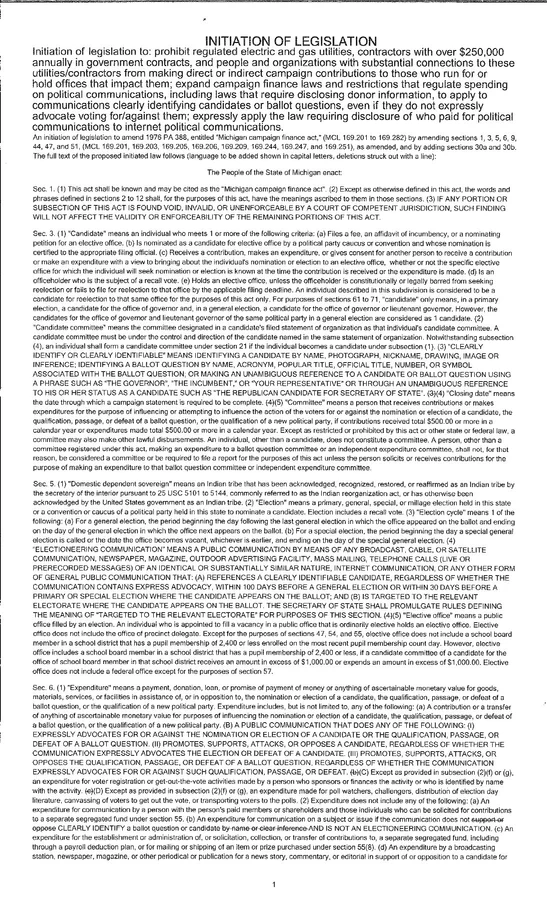
Open official PDF →
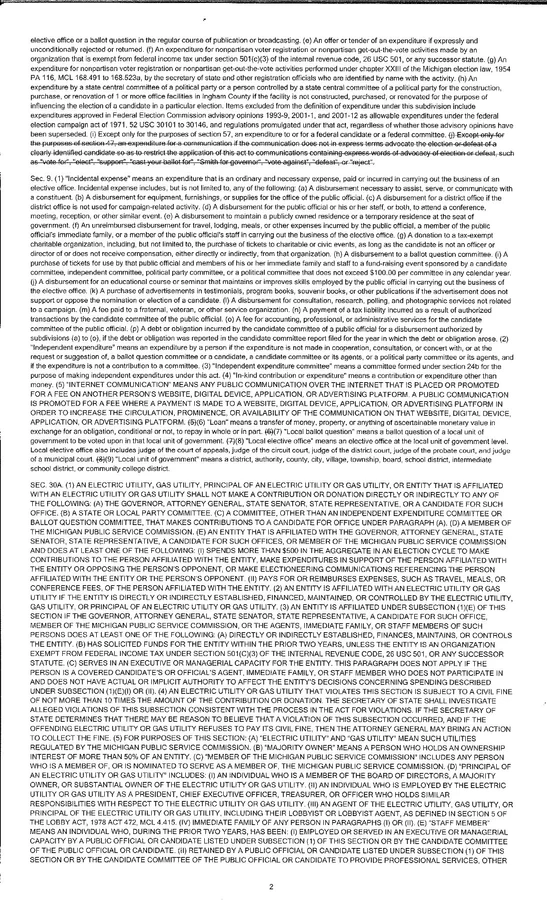
Open official PDF →
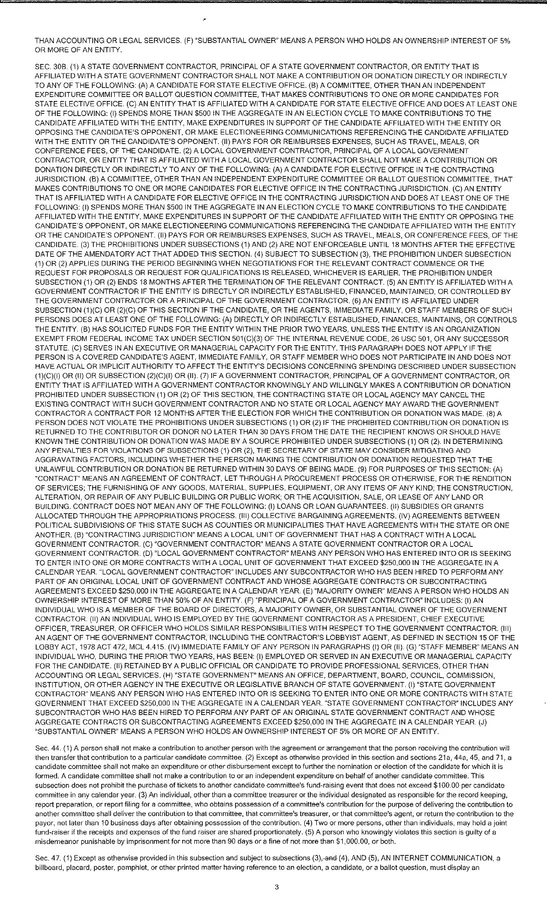
Open official PDF →
Open official PDF →
Sources and governing text
- Michigan Bureau of Elections: final 2026 ballot questions — official wording for both measures.
- Officially filed Proposal 2 petition — proposed law on PDF pages 3–6; independently inspected.
- Michigan Campaign Finance Act, current Legislature compilation — comparison with existing law, rendered October 24, 2026, through Public Act 114 of 2026.
- Michigan Constitution, current Legislature compilation — Articles II and XII; rendered October 27, 2026, through Public Act 114 of 2026.
- Senate Fiscal Agency: Proposal 2 analysis — explanatory and fiscal context.
Reporting and source checks: October 29, 2026. This explainer distinguishes the legal text, our analysis and attributed advocacy positions. Organizational positions are linked beside their descriptions and retain their original statement dates. Implementation questions are identified where the proposal leaves further work to officials or interpretation.